














Universities offering Co-op Programs in USA/Canada






Cooperative Education can be delineated as a fusion of classroom learning and practical work experience, which has emerged as a pervasive trend in several degree programs. It is popularly known as a 'Co-op program' and stands out as one of the veritable work-study options in the United States.
In essence, a Co-op program offers a blended learning experience with semesters of on-campus learning and full-time jobs.
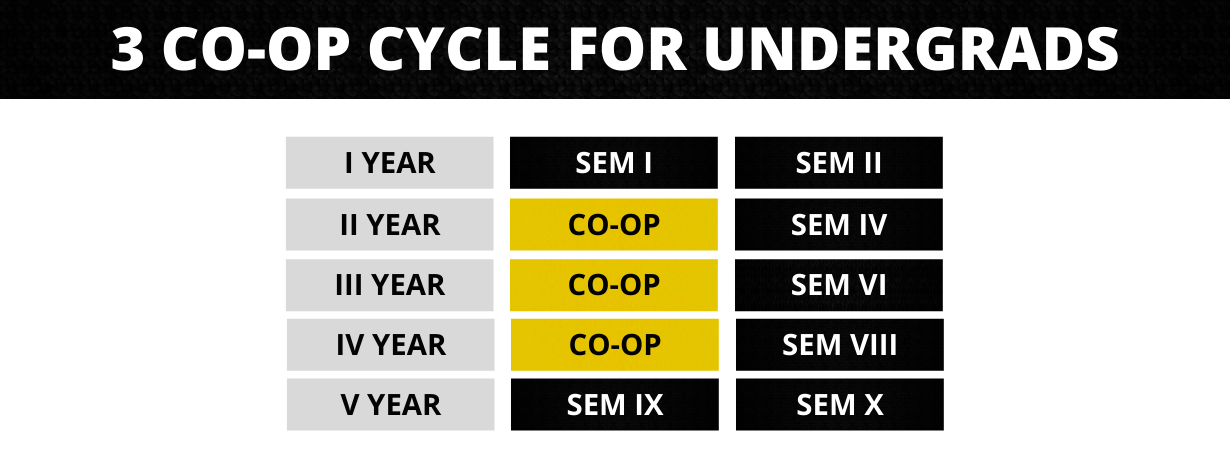
US nationals pursuing undergraduate degrees get the option to co-op for upto 3 semesters but this causes an extension in the program duration, resulting in 5 years of study. This can be described in the image below:

Co-op for International Students
It is important to note that even though a university may offer 1-3 co-op cycles, an international student must not exhaust their CPT over it because completing 1 year of CPT denies them from availing OPT.
Eligibility:
To be eligible for CPT, internationals must first complete two full semesters in F-1 status and be in good academic standing, making satisfactory progress towards their degree.
Length:
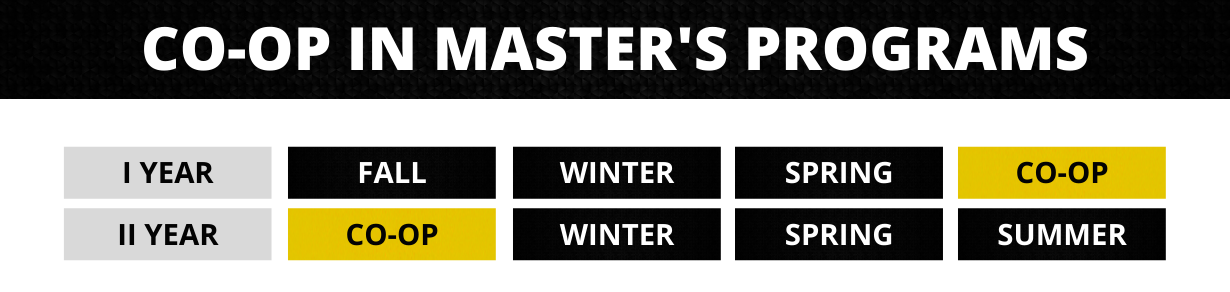
After the end of one year international graduate students generally have two semesters left for graduation so they alternate between co-op semesters and academic terms. They can co-op for a maximum length of 2 work terms. Although international undergraduates can co-op more than that, it is not recommended for them since it can exhaust their CPT.
Learn more about CPT and OPT here.
Co-op ensures that students earn course credits while enhancing their practical knowledge through a structured job experience. This initiative offers an intensive experiential learning in the industry as the individuals can dedicate an entire semester of full-time work to the co-op recruiters.
It also opens floodgates of opportunities for networking and employment as the co-op exposure can eventually leads to a permanent position in the same company.
A USNews article spotlights that students invest a significant amout of time in co-ops as compared to internships, which turns them into an asset for the firm they serve. Thus, they are also endowed with the unfair advantage of working on bigger projects unlike the interns.
This is why several co-op employers recruit the co-op graduates.
International students on F-1 visa can use Curricular Practical Training (CPT) for working as a co-op student.
Therefore, co-ops can be a silver bullet for staying ahead of the curve to become industy-ready after graduation.
Co-op vs Internships
| Co-Op | Internship | |
| Length | When students co-op, they engage in full-time roles over an extended period of time that can range from 6 months to 1 year. | This is not possible in the case of internships as the topmost length it can have is a couple of weeks. |
| Working hours | Co-op demands 35-40 hours of full-time employment. | International students are restricted to work for 10-20 hours per week during internships. |
| Credits | The schools where co-operative education programs are adapted not only offset the tuition for the co-op term, but also attach credits for the work performed. | This is not true for internships. |
| Classes | The students need not take classes during the co-op term and can focus completely on gaining meaningful work experience. | On the contrary, interns have to make time for taking classes or work part-time during vacations. |
| Learning | Co-ops paint a picture of what it is like to join the workforce and serve in a full-time position for a company. This offers a more in-depth learning experience. | The ephimeral nature of internships fail to provide such an extensive exposure to the students. |
| Earnings | For the semesters you participate in co-op, you not only gain experience in the world-of-work but save money that can pay for subsequent semesters | Internships can be unpaid and even if they are paid, students miss the chance to earn through multiple semesters of full-time work |
Also, given the additional time and efforts put in by the students, the compensation earned also takes an upswing! Interns usually do not earn as much.
Co-ops typically earn $8,000-$10,000 per work term as per the sources of Georgia Tech's Career Centre.
This makes it an important parameter while university shortlisting. To make it easier for you, we have already verified the universities that offer co-op! This list contains universities both from USA and Canada. Read on to learn about each of them below.
Kindly confirm the availability of co-op education for your own case based on your program in these universities.
1. Georgia Tech
Georgia Tech tops our list of co-op offering universities, given the abundance of opportunities it has to offer. The students can enroll into co-op courses by consulting their co-op advisors and also enroll into a co-op course in another university as well. The credit hours can be transferred to Georgia Tech by following certain procedures. GaTech's co-op initiative also includes an ambassador program wherein the participants are nominated by their program advisor. They have the chance to attend training sessions every semester and enjoy the benefits of creating strong relations with their employers.
Available for
Undergraduates: ✓
Graduates: ✓
2. Northwestern University
The engineering students of Northwestern earn 18-months of real-world experience in the industry as a part of the cooperative education program. Students are required to take the Introduction to Career Development course for co-op and international students are advised to connect with the concerned supervisor to confirm their eligibility. The students are also given a full-time status during work terms. Further, it is possible for the eligible students to receive a co-op remission grant that offsets the tuition increase for a fifth year of enrollment.
Available for
Undergraduates: ✓
Graduates: ✓
3. Northeastern University
NEU students have the privilege to earn 8 months of full-time employment and bring back their newfound industry knowledge to the classroom. Before moving on to explore potential careers through co-op, the students take the Career Management for Engineers course that prepares them to develop the prerequisite skills important for joining the workforce. A counsellor is appointed to the students during the search period who study their profile to help them get shortlisted by the co-op employers. The advisor offers guidance to develop the skillset as per market demands and helps with networking.
Available for
Undergraduates: ✓
Graduates: ✓
4. Drexel University
Drexel's co-op program preparation incepts from the first year and Steinbright offers support to help students tailer their education with future-goals. The students receive career counselling from the very first year so that they are in a good standing for the prospective opportunities during their time in Drexel. The university also offers international co-op, which opens the doors to secure co-op roles all around the world.
Available for
Undergraduates: ✓
Graduates: ✓
5. University of Cincinnati
The University of Cincinnati takes pride in producing graduates who are left with less debt at the end of their program, given the collective annual co-op earnings amounting to $65 million in the university. The university offers 6000 co-op placements annually in hundreds of companies spread across 22 countries. National students usually complete 3-5 co-op semesters and upskill themselves as per the needs of organizations. Often, their graduation ends with a permanent role in the company they served during their co-op experience.
Available for
Undergraduates: ✓
Graduates: ✓
6. Cornell University
Engineering co-op education program is available for the undergraduate students at Cornell. The average monthly salary for Cornell co-op students is $4686 per month, which is based on 40 hours per week. Depending on your needs you may work during the fall semester or spring semester or both. While you are working, you are enrolled "in absentia" and do not pay tuition for the semester. At Cornell, the co-op positions are secured via Handshake - a website for college students to get hired.
Available for
Undergraduates: ✓
Graduates: ❌
7. Purdue University
Purdue students can end their program with 12-20 months of co-op experience! The selected students receive offers from the Office of Professional Practice at Purdue but an interview call does not ensure confirmed co-op position in the respective company. The end of a co-op term is marked with four assessment items for securing a completion grade. These items include a student work report, an essay covering the questions asked as a part of the assessment, student evaluation by company, and company evaluation by student.
Available for
Undergraduates: ✓
Graduates: ❌
8. Rochester Institue of Technology
The students can co-op for up to two consecutive terms at Rochester Institute of Technology. At Rochester, you also get to build connections with high-paying employers in New York City for the co-op role and have the chance to convert it into a permanent role after graduation. There are two kinds of co-op at RIT: RIT on-campus co-op where you work as an RIT employee and Entrepreneurial co-op. For the latter, students do not work under an employer and explore their entreneurial drive instead. Rochester boasts about offering paid co-op roles to their students that can help them ease the burden associated with funding.
Available for
Undergraduates: ✓
Graduates: ❌
9. Stony Brook University
Stony Brook lays special emphasis on learning by doing and presents a diverse range of experiential initiatives. Stony Brook's Career Centre flourishes with opportunities including cooperative education and other experiential learning opportunities like fellowships, job shadowing, and internships. In addition, the students get the opportunity to build connections with New York-based high-tech companies for co-op roles and gain an extended experience with cutting-edge technologies while working with such firms.
While internships may be paid or unpaid, co-ops are always paid in Stony Brook.
Available for
Undergraduates: ✓
Graduates: ❌
10. George Washington University
The co-op program at George Washington University must occur more than 20 hours per week during a semester or 40 hours per week during an official university break for international students. The university offers both paid and unpaid positions and the designations conform with the standards of U.S. Department of Labor’s test. A transcript documentation that exhibit Pass/No Pass designations marks the end of a co-op term for a student. The co-op advisors are accountable for reporting a GW Co-op Student Evaluation that is seminal for receiving the co-op certification in the degree.
Available for
Undergraduates: ✓
Graduates: ❌
View George Washington University Admission Statistics ❯
Other universities offering Co-op

-

Texas A&M University
Available for Graduates: ✓ Undergraduates: ✓
-

Stevens Institute of Technology
Available for Graduates: ✓ Undergraduates: ✓
-
George Mason University
Available for Graduates: ✓ Undergraduates: ✓
-
Florida State University
Available for Graduates: ✓ Undergraduates: ✓
-

Lehigh University
Available for Graduates: ✓ Undergraduates: ✓
-

Rensselaer Polytechnic Institute
Available for Graduates: ✓ Undergraduates: ✓
-

University of Vermont
Available for Graduates: ✓ Undergraduates: ✓
-
Elon University
Available for Graduates: ✓ Undergraduates: ✓
-

Endicott College
Available for Graduates: ✓ Undergraduates: ✓
-
Bentley University
Available for Graduates: ✓ Undergraduates: ✓
-

Clemson University
Available for Graduates: ✓ Undergraduates: ✓
-

Georgetown University
Available for Graduates: ✓ Undergraduates: ✓
-
Worcester Polytechnic Institute
Available for Graduates:❌ Undergraduates: ✓
-

Butler University
Available for Graduates:❌ Undergraduates: ✓
-

La Salle University
Available for Graduates:❌ Undergraduates: ✓
-

Temple University
Available for Graduates:❌ Undergraduates: ✓
Some of the colleges in Canada offering Co-op education programs:
- Centennial College
- Georgian College
- Fanshawe College
- George Brown College
- Conestoga College
- Humber College
We will be adding a list with universities offer Co-op for master's programs. Sign up to get notified of the same via email!