















How to Apply for a US Visa? Easy Step-by-Step Guide





.jpg)
Getting a visa for the United States may seem daunting, but don't be underconfident! It's actually quite manageable if you follow the steps carefully. We're here to break it down for you in an easy-to-understand way, so you can go through the process smoothly.
Let's make your USA visa application journey stress-free!
What is a US Visa?
A citizen of a foreign country who seeks to enter the United States generally must first obtain a U.S. visa, which is placed in the traveler's passport as a stamp. There are two categories of visas: immigration and non-immigration. Within these categories are several classifications, such as student visas, work visas, visitor visas, etc. You can choose the type of travel you want according to your purpose in the United States of America.
Which US Visa Type You Need?
Before you start applying for a visa to the United States, it's super important to pick the right visa type for why you're going. Each visa type has its own rules you gotta follow, and you need to have all the right documents for your visa interview. So, make sure you choose the right one!
Let's look at some of the popular Visa types:
Visa Type | Purpose | Classification |
F-1 | Studying in the US for either Bachelor's or Master's | Student Visa |
F-2 | Dependents of F-1 Visa holders (Students) | Student Dependent Visa |
B-1 | For Business meetings, negotiations, conferences | Business Visa |
B-2 | For Tourism, visiting friends, medical treatments | Visitors Visa |
M-1 | Vocational students, Flight Training | Student Visa |
M-2 | Dependent on the M-1 holder | Student Dependent Visa |
H-1B | To work in a specialty occupation in the US | Work Visa |
H-4 | Non-immigrant dependents (spouse and children under 21 years of age) of H-1B visa holders | Work Visa |
J-1 | For students who participate in exchange visitor programs in the United States | Exchange Visitors Visa |
J-2 | Children under the age of 21/spouse of J-1 holder | Exchange Visitors Visa |
K-1 | Fiance | Fiancé Visa |
K-2 | Dependents on the K-1 holders | Fiancé Dependent Visa |
US Visa Application Process
Once you select your Visa type, you must complete the online application process. If you are applying for a nonimmigrant visa, you must complete the DS-160 form. If you are applying for an immigrant visa, you must complete the DS-260 form.
DS-160
The DS-160, Online Nonimmigrant Visa Application form, is for temporary travel to the United States and K (fiancé(e)) visas. Consular Officers use the information entered on the DS-160 to process the visa application and, combined with a personal interview, determine an applicant's eligibility for a nonimmigrant visa.
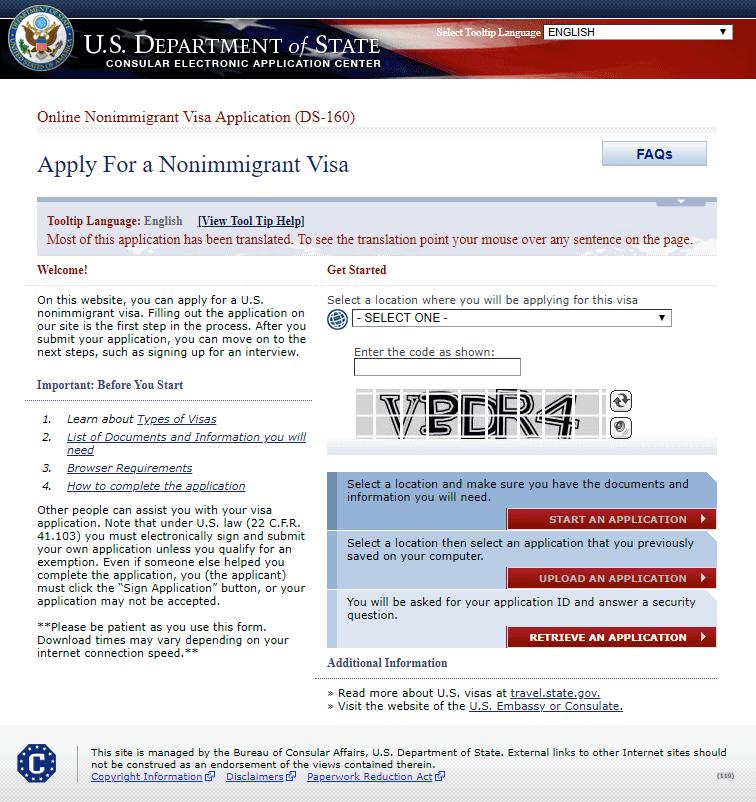
Filling the DS-160 is not a hard task. Below are the steps for completing the application procedure:
- Go to Online Non-immigrant US Visa Application (DS-160 form)
- Select the location where you plan to apply for a Visa
- Enter the Captcha that you see below there
- Click on "Start An application"
- Answer all the questions accurately in English
- Submit the Form
- Print DS-160 Barcode Page
Creating an Account For a US Visa Appointment
After you have completed the online US Visa Application (DS-160) form, you need to create an account in the new US Visa Appointment booking system. It is straightforward. Below is a step-by-step guide.
Step 1 - Open the new website
As per the latest updates from the US Embassy, the appointment booking system for India, Japan, Korea, and Fiji is available at www.usvisascheduling.com. If you reside in other countries, you must apply only via www.portal.ustraveldocs.com.
Step 2 - Enter a User name, Verify Email
First, you must choose a username, set a password, and validate the email. In the password fields, enter a password that meets the system's standards and re-enter it. After that, click on the "Send Verification Code" button to get your email verified.
Step 3 Answer the Security Questions
You will now be asked to enter your name and surname and answer three security questions. Please enter these details.
Step 4 Sign in and Start the New Application
- You will After you enter all the security questions and your name, verify all the details once, like your user name and email, and click on the "Create" button at the bottom. You will be redirected to the home page, where you must enter the username and password, enter the Captcha Text, and click the Sign in button.
- Once you are signed in, you will see options like "Start an Application," "Manage Applications," etc. Depending on your situation, you can perform respective actions.
- Upon starting a new application for an F-1 Visa, you must answer all the listed questions carefully and always remember to cross-check details from your passport and the I-20 form.
US Visa Application Fees
Depending on the country you are attending and the type of visa, you may be asked to pay additional fees, such as visa issuance fees or the SEVIS fee for an F1 visa applicant. You are required to pay a certain fee for your US Visa. It is also called a Machine Readable Visa (MRV) fee.
Here's a list of some important Visa types and their application fee:
Visa Type | Fee in USD |
F-1 | $185 |
F-2 | $185 |
B-1 | $185 |
B-2 | $185 |
M-1 | $185 |
M-2 | $185 |
H-1B | $205 |
H-4 | $205 |
J-1 | $185 |
J-2 | $185 |
K-1 | $265 |
K-2 | $265 |
US Visa Interview Appointment
Once you have submitted the online application form and supporting documentation, the US Embassy Visa Application Center (VAC) must process it. Once the application is processed, a visa appointment must be scheduled. You must look for slot dates according to your program start date and monitor them daily, as they can open anytime.
If you want to get your visa faster, book our Visa Application Help service! We can assist you with the paperwork, financial planning, and visa Interview mock rounds.
Conclusion
We hope this blog post has provided valuable insights on the US Visa application process. If you are all set with your documents and applications but stuck in the final and most important phase, the visa interview, you must book a session with us for a US Visa Mock Interview! We will ensure that you ace the interview with proven tricks and techniques under the guidance of our experts.
Get Guidance from our Expert Counsellors and find your Dream Career!
Frequently Asked Questions!

F-1 students are allowed to work part-time on campus during the academic year and may be eligible for Optional Practical Training (OPT) or Curricular Practical Training (CPT) for off-campus employment related to their field of study.

F-1 student visas are typically issued for the duration of your academic program, plus an additional 60 days after completion of your studies (known as the grace period).
While both visas are for students, the F-1 visa is for academic studies at accredited institutions, while the J-1 visa is for exchange programs, including study, research, or teaching.
Yes, international students may apply for a US green card through various pathways, such as employment sponsorship, family sponsorship, or the Diversity Visa Lottery Program. Each pathway has specific eligibility criteria and application processes.
Dependents, such as a spouse or unmarried children under 21, can accompany F-1 visa holders on an F-2 visa. They are not permitted to work but may attend school part-time.
The J-1 visa is for individuals participating in approved exchange visitor programs, including students, scholars, and interns. The process involves obtaining a Form DS-2019 from a designated sponsoring organization and applying for the visa at a US embassy or consulate.
International students wishing to extend or renew their student visa must typically apply for an extension through their designated school official (DSO) and follow USCIS guidelines. The process may involve submitting additional documentation and paying applicable fees.
The SEVIS fee is a must-pay fee for F-1 visa applicants. You have to pay it at least three days before your visa interview.
Yes, you can travel outside the US and re-enter using your valid F-1 student visa, provided you have all required travel documents and a valid I-20 with a travel endorsement from your designated school official.
It's recommended to apply for your US student visa as soon as you receive your Form I-20 from your intended US institution. Visa processing times may vary, so it's best to apply well in advance of your intended travel date.
As an international student, you typically need an F-1 student visa to study at a university or college in the United States.