















Get your student visa and fly off to Germany! - A comprehensive guide.






Ready to put down your roots in the land of Poets and Thinkers and cultivate your intellect with their genius academic community? A country that narrates rich history through old fashion and colorful architecture, Germany remains one of the top destinations to nurture your personality and your soul. Apart from its picturesque palaces and landscapes, the country attracts individuals from all over the world owing to its no-tuition policy for domestic and international students alike! Yes. You can study there absolutely free of cost. There you have it: the ultimate end station for your academia!
Germany is one of the world's most coveted study destinations and we look at you with rose-colored glasses (or beer-filled glasses ;)) as you contemplate landing there too. But first, there is a complex stumbling block to be overcome - applying for a student visa! Okay, we will make it easy for you. Are you ready for this? Read on!
Do you NEED a student visa to study in Germany?
Yes, the obvious question first! Germany has varied benchmarks when it comes to needing a student visa for your education in the country. Let us review those right now so you can decide if you need to keep reading the article ;)
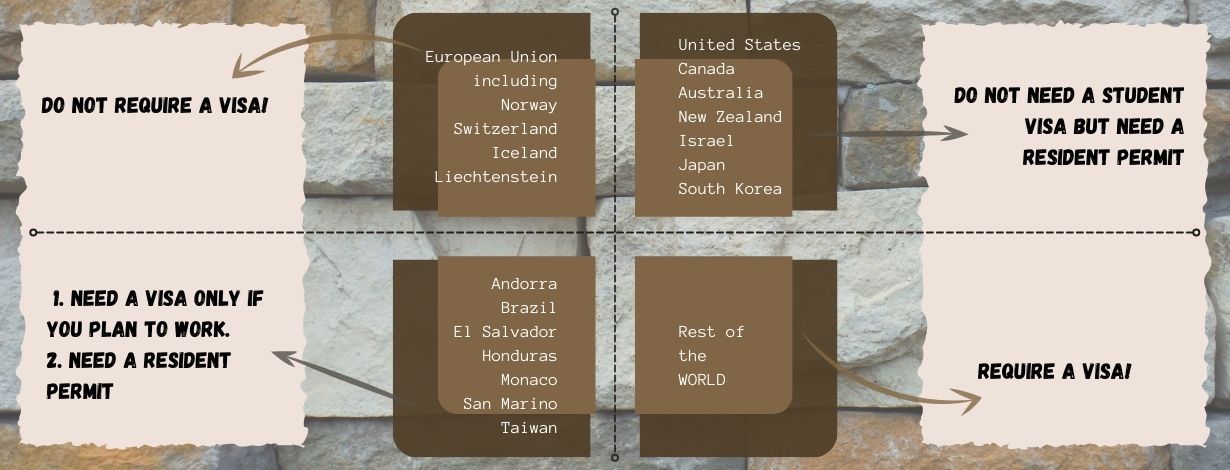
Candidates hailing from: the European Union (including Liechtenstein, Switzerland, Norway, and Iceland)
Rejoice! You do not need a German student visa to enter the country.
Candidates hailing from: South Korea, the US, Australia, Canada, New Zealand, Japan, Israel
You do not need a student visa to study in Germany if you are from one of these countries. However, you must register at the local Resident's Registration Office and Aliens' Registration Office within two weeks of your arrival in order to obtain a resident's permit.
Candidates hailing from: San Marino, Brazil, Andorra, El Salvador, Monaco, Honduras, Taiwan
Are you a citizen of any of these countries? A German student visa is only required if you intend to work in Germany before or after completing your degree. You must apply for a visa in your home country through your local German embassy or consulate.
Furthermore, both visa and non-visa holders must apply for a residence permit within two weeks of entering the country.
Taiwanese students must also have a passport with their identity card number.
Candidates hailing from: the rest of the world
Students from all over the world, with the exception of the aforementioned countries, must obtain a German student visa. You must apply for a visa in your home country through your local German embassy or consulate.
Types of German student Visas
There are three types of student visas that you can apply for if you are visiting the country for your educational pursuits. Let us have a look at them so you can decide which one suits your needs the best.
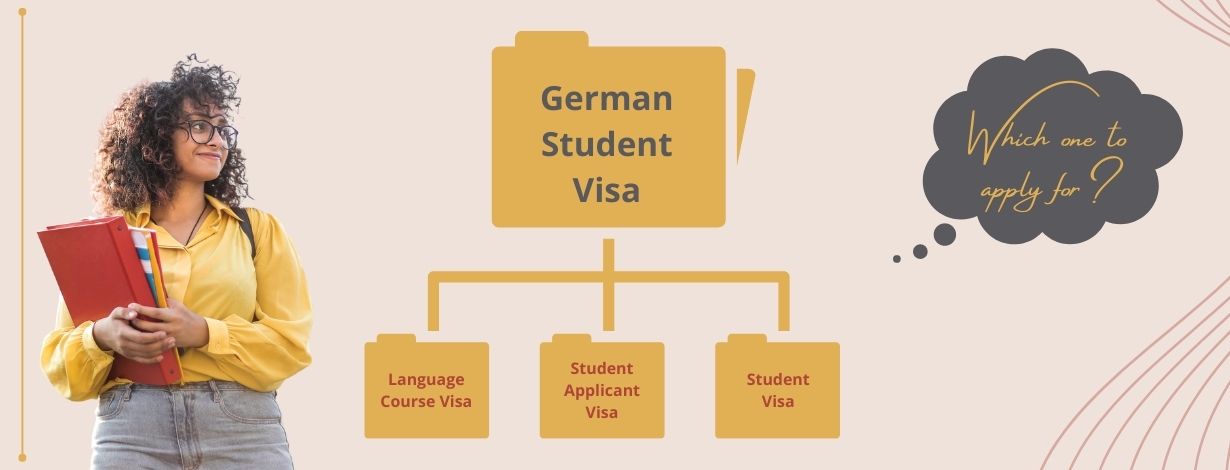
1. Language Course Visa
This visa is granted to foreigners who intend to complete a 3-12 month intensive language course. Your courses should contain a minimum of 18 hours of lessons each week. You cannot convert this type of visa into a student application visa or a work permit or undertake any gainful employment. Moreover, the language course visa doesn't allow you to apply for university admissions or commence your studies.
If you plan on proceeding with your studies immediately after completing the language course, you must return to your native land and apply for a German student visa. This cannot be done while you are still in Germany.
2. Student Applicant Visa
You will need a student applicant visa if you have applied for university studies and have been confirmed as an applicant. With this visa, you are given a period of three months to fulfill the admission requirements such as undertaking an examination or an interview. Moreover, it can be extended to nine months through the residence permit. However, you cannot stay longer than this period in case of not being admitted.
Additionally, if you receive official acceptance in your preferred university, you can switch this visa into a student visa.
3. Student Visa
Have you already received a letter of complete admission from your dream university? This is the visa you need!
Are you wrecking your nerves trying to obtain a German student visa? Say no more! Consider us a genie who you can summon with a single click to help you with the entire process from the beginning till the end -->
Application Process
Now that you know what visa type to apply for, let's have a look at HOW to apply for it!
First and foremost, apply for the visa and set up an appointment for the visa interview at the German Embassy or Consulate in your home country. Now all you need is to prepare for the interview questions that the consular office poses in order to examine you as a potential visa candidate. Are we forgetting something? YES! The documents. There is an extensive list of documents you need to check before sitting for the interview. Let's go over them!
Documents

#1. Two filled-out national visa application forms
#2. Authentic national passport
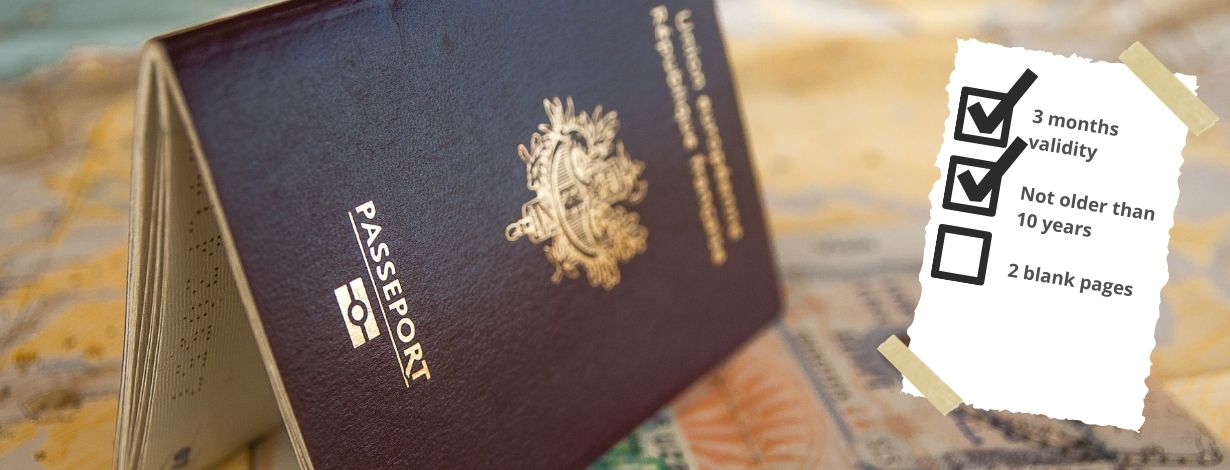
A passport is one of the most important documents, and if it does not meet the requirements, your application will be automatically rejected by the consular. Before we go any further, let's take a look at the passport prerequisites.
Requirements for a Passport
- It must be valid for at least three months after your planned departure from Germany.
- It must be no more than ten years old on the day you plan to leave Germany.
- It must have at least two blank pages to which the visa can be affixed. Passports with additional pages added later on, on the other hand, will be rejected.
- Passports with illegible information will be rejected.
- Passports that have been damaged will be rejected.
#3. Two recent biometric portrait photographs
No no. Put your exquisite, black and white portraits on the side. Germany has other plans for your photographs! Shall we review them?
Visa Photograph Requirements
- Make sure your face fills 70-80 percent of the frame.
- Make sure the lighting is even. Face shadows, flash reflections, and red eyes should be avoided.
- There must be only one person in the photograph.
- Pose in a centered position that isn't too close or too far away.
- The photograph must be taken in front of a neutral grey background. If you have light-colored skin and hair, the photo should be taken against a medium-gray background. Similarly, if you have a darker face and hair, use a light-gray background.
- Keep your background shadows to a minimum.
- Your photo should not be blurry and should have a sharp focus and adequate contrast.
- Keep your hair out of the way, and if you wear glasses, turn off the flash reflections. Furthermore, hats or head coverings are not generally permitted, but exceptions are made for religious reasons.
- The photo must be printed on high-quality paper with a resolution of at least 600dpi. Photos can be in either black and white or color.
#4. Proof of admission at a German education institution
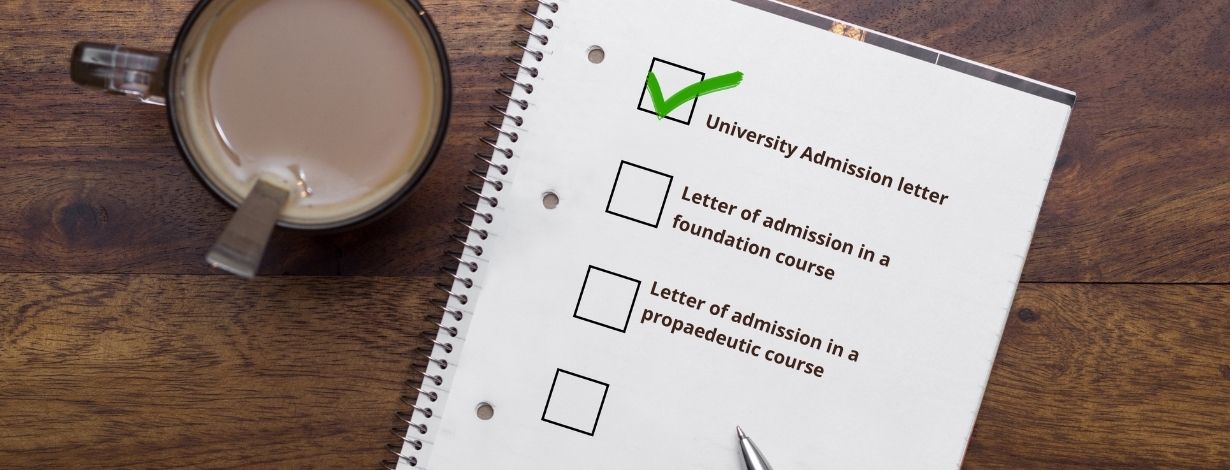
Send any of the following documents as proof of admission:
- Admission letter to university
- Admission letter to a foundation course
- Admission letter to the propaedeutic course
- Admission letter to a preparatory German language course
#5. Proof of English language proficiency (for English and mixed-language study programs)
- Test of English as a Foreign Language (TOEFL)
- The International English Language Testing System (IELTS)
#6. Proof of German language proficiency (for German only and mixed language study programs)
- German language university entrance examination for international applicants (DSH)
- Test of German as a foreign language (TestDaF)
- Goethe Institute German language diploma
- German Language Diploma of the Standing Conference of the Ministers of Education and Cultural Affairs, Level II (DSD)
#7. Authenticated certificates of earlier education
- German university entrance qualification.
- Recognized foreign academic qualification
- Academic records or transcripts

#8. Student health insurance
You must have at least 30,000 EUR in coverage that is valid for at least three months. Dr. Walter's tariff Educare24 meets all requirements and is accepted by all German consulates worldwide. Go ahead and insure yourself!
#9. Curriculum vitae
It must be accompanied by proof of previous and current internship and work experience, if applicable.
#10. Motivational letter
Here comes the chance for you to express your reason for choosing a specific university or a study program. You mention your study plans and talk about your career goals in a way that increases your chances of admission to the university.
Are you having trouble drafting your motivational letter/statement of purpose? Allow us to help you - get a professional SOP draft with a click of a button!
#11. Marriage certificate (if applicable)
#12. Proof of having paid the German student visa application fee
The visa application fee is 75 EUR for applicants above 18 years old and 37.50 EUR for applicants below it.
At last, coming to the most important point on the checklist. Are you still reading carefully?!
#13. Means of subsistence
You must provide evidence to prove that you have enough money to cover living, accommodation, and study costs. Send any one of the following:
- Blocked bank account
A blocked bank account is a type of account available to international students in Germany. When applying for a student visa, you will be required to deposit the amount of money that will cover your living expenses for a year as proof of your financial resources. At the moment, the mandatory amount that must be submitted is 10,332 EUR. Once you begin your first semester in Germany, you will be able to withdraw 861 EUR per month. Fintiba is one of the simplest sources to open a German blocked account.
- A letter of commitment from a German resident indicating that they will cover your accommodation and living expenses while you are there.
- A letter of declaration from a parent indicating their financial commitment to supporting you during your stay in Germany. It must be supplemented by their most recent six-month bank statements.
- Scholarship awarding certificate indicating your status as a recipient and the amount of financial assistance provided by this scholarship.
Now that you have a comprehensive checklist for the documents needed during the visa application process, you can prepare for the interview!
Visa Interview
If you are done sorting your documents, here comes the next essential part. Preparing for the interview - your chance to get the counselor into accepting your visa! Don't worry! While no one can conclusively list the exact questions asked in the interview, we will help you with some of the basics.
Firstly, make sure you are sure about why you have chosen to study in Germany when there are varied options available like the USA and Canada. You can mention the affordability of the education there, apart from the quality. Study in-depth about the universities you have applied to and the coursework. The interviewers would want to know if you are actually serious about this next step ahead of you. If they happen to ask you about your grades or scores in your academic journey till now, be sure to answer it honestly and confidently. They probably already have all the information already and want to check how honest you are willing to be. Being truthful is one of the most essential parts of the interview. You can supplement your answers beautifully and defend your scores without having to provide false information. Additionally, be clear about your accommodation plans and your means of subsistence. And this comes without having to say it - know the basics of the country you are proceeding to!
All in all, you have an idea now - know in-depth about your course, the university you are applying to, the country you will be staying in, and your means of subsistence. That's it you are all set! But wait, there's more ;)
Quick Tips
1. Attend the interview on time. Not too early, and certainly not too late! Arrive a few minutes early to gather your thoughts and breathe. To make a good impression, make sure to greet everyone on the team.
2. It is not advisable to drive on the day of the interview. With the day already being stressful, you don't want to waste time and effort looking for a free parking spot. Take a taxi or arrange for someone to drive you to the Embassy.
3. Wear outfits that are comfortable and not ostentatious. You can look confident by wearing a dress or a formal suit.
4. Don't forget the documents! We made you a checklist above - do make sure to have originals as well as two copies of each document.
5. Answer all the questions directly and honestly. Do not exaggerate or beat around the bush. To the point and honest answers are what the interviewers are looking for!
Winding Up!
Now that you know the intricacies behind applying for a German student visa, we hope you all the best in your academic and professional endeavors. With our checklists, tips and guides, you are ready to crack that interview and pack your bags to land in this dazzlingly beautiful country.
Team YMGrad.
Is your mind fogged up by the numerous choices of German universities in front of you? Search your DREAM university, rate your chances and much more with us!
Related Posts
IELTS Reading: Tips and Tricks for a perfect 9!