














EB-1 Visa: The Complete Guide





Imagine bypassing years of visa lotteries, employer dependencies, and green card backlogs. If you’re a researcher with breakthrough discoveries, an athlete with international acclaim, an artist reshaping your field, or an executive leading global innovation, the EB-1 visa isn’t just another immigration pathway - it’s the fastest legal gateway to U.S. permanent residency. Apart from talent, this exclusive track demands meticulously documented evidence that you rank among the world’s best. Here’s a deep dive into how to qualify and strategize your application.
What is an EB-1 Visa?
The EB-1 (Employment-Based First Preference) visa is designed for individuals with extraordinary abilities, outstanding academic achievements, or executive/ managerial expertise. Unlike other employment-based visas, which are often shackled by labor certifications and require decade-long waits, the EB-1 rewards proven excellence, not just employment. EB-1 offers a streamlined path to a U.S. green card with three major advantages:

No labor certification (PERM) required
Priority processing with minimal backlog
Direct route to permanent residency (green card)
EB-1 Categories & Eligibility
There are three categories in the EB1 visa, which pertain to individuals from distinct backgrounds.
1. EB-1A: Individuals with Extraordinary Ability
This category is reserved for individuals who have achieved the pinnacle of their respective fields, whether in the arts, sciences, education, business, or athletics. When applying under EB-1A, you must demonstrate your worth by providing evidence of national or international recognition for your work through various types of documentation.
Eligibility Criteria [Source]

One-time major award (Nobel, Oscar, Olympic Medal), OR
3 of the following 10 criteria:
- 1Nationally/ Internationally recognized awards: You must have evidence of receiving nationally or internationally recognized prizes or awards of repute for your excellence.
- 2Membership in elite associations: You should demonstrate your membership in associations in the field that require outstanding achievement from their members.
- 3Published material about your work: You must have evidence of published material about you in professional or major trade publications or other major media. It can include copies or links to articles or features about you in well-known publications.
- 4Judging others’ work in your field: You need to submit evidence that you have been asked to judge the work of others, either individually or on a panel.
- 5Original significant contributions: It includes evidence of your original scientific, scholarly, artistic, athletic, or business-related contributions of major significance to the field. It must show that your work has been important or impactful in your field.
- 6Scholarly articles in major publications: Provide evidence of your authorship of scholarly articles in professional or major trade publications or other major media. You can submit copies of articles or research papers you have published in respected journals or other trusted media.
- 7Artistic exhibitions or showcases: Evidence that your work has been displayed at artistic exhibitions or showcases. You should provide proof that your work has been displayed in galleries or artistic showcases.
- 8Leading/critical role in a distinguished organization: You should provide evidence of your performance in a leading or critical role in a distinguished organization. Proof of playing a significant role in large organizations can include records of leadership or key contributions you made.
- 9High salary (significantly above peers): Proof of earning a high salary involves presenting documents that confirm your earnings are considerably higher than those of others in your field.
- 10Commercial success in performing arts: Evidence of your commercial successes in the performing arts. You must prove your financial success through records of strong sales or high revenue from work, etc.
2. EB-1B: Outstanding Professors and Researchers
This category is for outstanding professors and researchers who are entering the U.S. to continue their work in their respective areas of teaching and research. When applying under EB-1B, you must demonstrate sustained contributions to your area of expertise and have at least three years of experience in teaching or research. Additionally, you must have a job offer for a tenured or tenure-track teaching position or a relevant research position in the U.S. from a private employer that employs at least 3 full-time researchers and has documented accomplishments in that field.
Eligibility Criteria [Source]
Job offer from a reputed U.S. university/research institution
.3+ years of teaching/research experience in a related field.
2 of the following six criteria:
- 1Awards: You must have received reputed prizes or awards of repute for outstanding achievement.
- 2Membership: You should demonstrate your membership in associations in the field that require their members to demonstrate outstanding achievement.
- 3Published material about you: Evidence of participation, either on a panel or individually, as a judge of the work of others in the same or allied academic field.
- 4Judging others’ work in your field: You must offer proof of original scientific or scholarly research contributions in the academic field.
- 5Original Contributions: It includes evidence of your original scientific, scholarly, artistic, athletic, or business-related contributions of major significance to the field. It must show that your work has been important or impactful in your field.
- 6Authorship: You must have authorship of scholarly books or articles (in scholarly journals with international circulation) in the field.
3. EB-1C: Multinational Executives and Managers
EB-1C caters to senior executives and managers of international companies who are being transferred to the United States from another foreign office of the same company. Under this category, you need a job offer letter. The U.S. employer must be a parent, subsidiary, affiliate, or branch of the company that you work for.
Eligibility Criteria [Source]
Employed for at least 1 year out of the past 3 years with a qualifying foreign entity of your petitioning employer.
The US employer must be a branch, subsidiary, affiliate, or parent company of the foreign entity.
The applicant must be employed in or offered a managerial or executive role.
The US company must have been doing business for at least 1 year.
Key Advantages of the EB-1 Visa
| Feature | Benefits |
|---|---|
No PERM / Labor Certification | Saves up to 10 years vs EB-2/EB-3 visas |
Priority Processing | Shorter wait times |
| Family Inclusion | Spouse and children under 21 get green cards |
| Dual Intent | Allowed even on non-immigrant visas (e.g., H-1B, L-1) |
| No Employer Sponsorship | Self-petition permitted (EB-1A); Greater freedom to work freelance, launch a startup, or change jobs freely |
Documents Required for an EB-1 Visa
Applying for an EB-1 visa requires presenting several documents to help prove your qualifications. The following is a general list of required documents that may be expected:
General Documents:
- aPassport: A copy of your current, valid passport
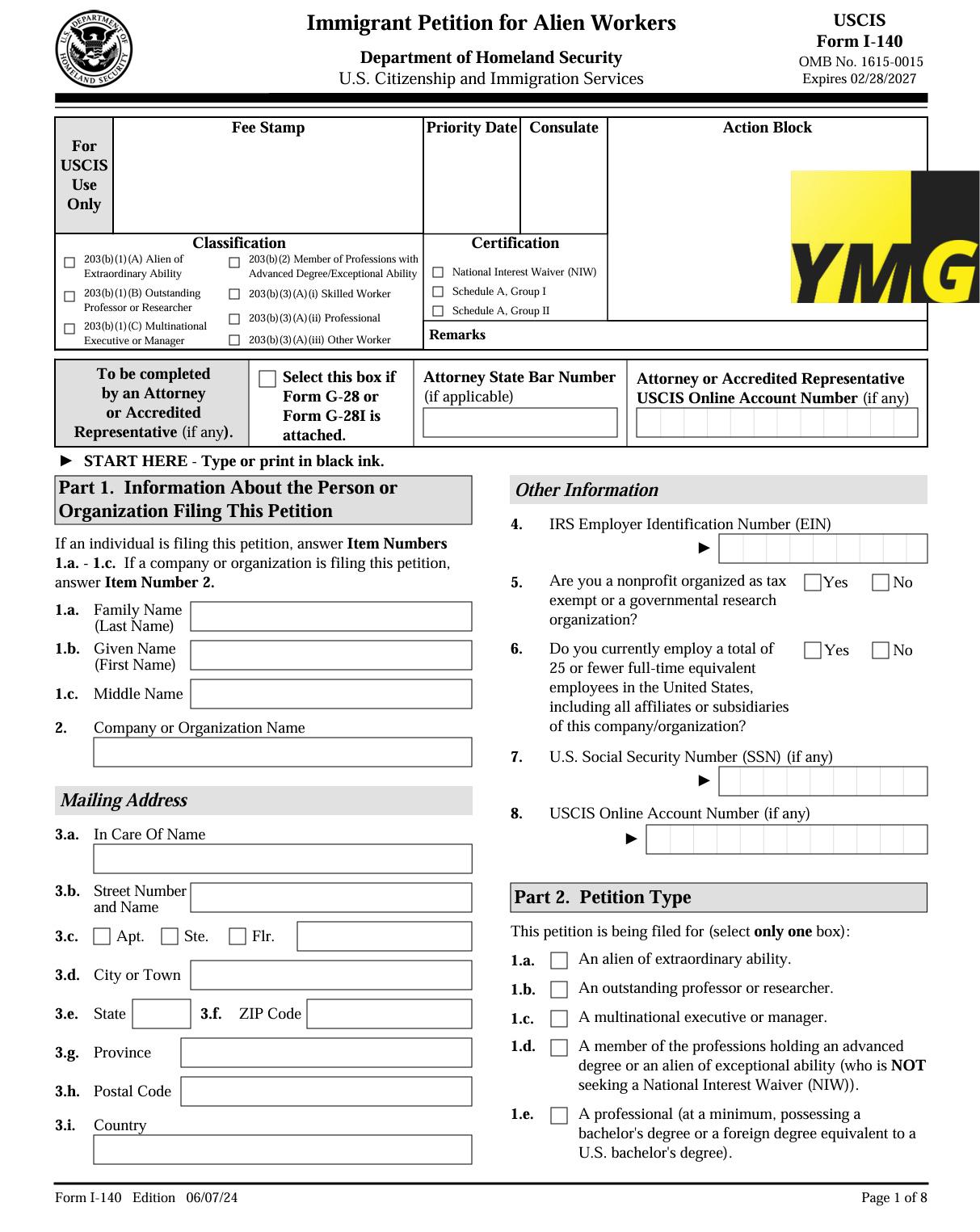
- bForm I-140: This is the Immigrant Petition for Alien Worker, completed and signed by you
- cForm I-485: Application to Register Permanent Residence or Adjust Status (if filing in the U.S. with an active non-immigrant visa)
- dForm G-325A: Biographic information (if needed)
- eForm I-94: Arrival/Departure Record (If you are already in the US)
- fPassport-sized photos: Normally, two copies of your recent photo are required.
- gFiling Fee: The filing fee varies depending on your visa type

EB-1A-Specific Documents:
Evidence of National or International Acclaim
Documentations such as awards, memberships, publications, or media coverage.
Letters of Recommendation
You can obtain these from peers, colleagues, or experts in your field who attest to your extraordinary ability.
Evidence of your work
Documents to prove your contributions in that specific field.
EB-1B-Specific Documents:
Job Offer Letter
It should be from a university or an employer in the USA.
Letters of Recommendation
From recognized experts in your field.
Evidence of International Recognition
Publications, research contributions, or awards.
Employment Verification
Proof of at least three years of teaching or research experience in your field.
EB-1C-Specific Documents:
Employment Letter
From your U.S. employer, confirming your role as an executive or manager.
Evidence of Employment Abroad
Documentation proving you worked for the same company outside the US for at least one year.
Company Information
Documents showing the relationship between the U.S. company and the foreign company (e.g., parent-subsidiary relationship).
 #
#Additional Documents:
- aEducational Credentials: Diplomas, degrees, and relevant certificates.
- bTranslation of Documents: If any documents are in a language other than English, you will have to provide certified translations.
Fees & Costs
FORM | FEE | INFORMATION |
|---|---|---|
| I-140 | $715 | Petition for Immigration |
| DS-260 | +$345 | Consular Filing (not applicable if filing within the USA) |
| I-485 | +$1440 | Adjustment of Status (Only applicable if filing within the USA) |
| I-907 | +$2,805 | Premium Processing |
What is the EB-1 application process?
In the EB-1 visa application process, several steps must be taken, including preparing the required documents, filing a petition, and, if approved, adjusting status to that of a permanent resident. The general process is summarized below:
- 1
Evaluate Eligibility:
Self-Evaluation
An individual must evaluate whether they are eligible to file under any of the three subcategories of EB-1: EB-1A, EB-1B, and EB-1C.
Consult with an Attorney (Optional)
Many applicants, due to the complexity and eligibility criteria required for obtaining an EB-1 visa, often consult with an immigration attorney to determine if they qualify for this particular visa category. They also receive assistance from attorneys to prepare comprehensive applications.
- 2
Gather Evidence:
Supporting Documents
You must show that the various eligibility conditions have been met. These could include proofs of awards, publications, letters of recommendation, employment records, and other relevant documents.
Employer Evidence (if required)
Your U.S. employer will need to provide specific documents, such as the employment offer letter, proof of the company's operation, and your job description.
- 3
File I-140 Petition: Immigrant Petition for Alien Worker
File Form I-140
This is the official petition to USCIS for an EB-1 visa. The applicant may file for an EB-1A visa or have their U.S. employer file on their behalf in cases of the other two subcategories (EB-1B or EB-1C).
Submit and Pay
Submit all required supporting documents for your case and pay the filing fee for the form. The current fee is $715; however, please visit the USCIS website for the most up-to-date information.
.jpg)
- 4
USCIS Review
Initial Review
USCIS will conduct an initial review to determine whether the petition is complete and that all necessary documents have been submitted.
Request for Evidence (RFE) (if applicable)
If the USCIS determines that it requires additional information or evidence to review your application, it will issue a Request for Evidence (RFE). If you receive it, you will need to mail the requested information within the specified timeframe.
- 5
Petition Approval or Denial
Approval
If the Form I-140 is approved, then USCIS will notify either you or your employer. Your next steps will depend on whether you are inside or outside the United States.
Denial
If the petition is denied, USCIS will inform you of the reason(s) for the denial. You can either appeal or reapply with more evidence.
- 6
Adjust Status or Consular Processing
Consular Processing (Outside the U.S.)
Once Form I-140 is approved, your case will be transferred to the National Visa Center (NVC), which will process your visa application. You must submit the Online Immigrant Visa and Alien Registration Application (Form DS-260). The NVC will then schedule an interview at the U.S. Embassy or Consulate in your home country. You have to attend this interview, along with all necessary documents.
Adjustment of Status (For those having a non-immigrant visa)
When your Form I-140 (Application to Register Permanent Residence or Adjust Status) is returned as approved, and you are in the U.S. under a nonimmigrant visa, you will be permitted to adjust your status to that of a permanent resident. You may be required to attend a biometric appointment to provide fingerprints, photographs, and a signature. Depending on your case type, an interview may be necessary to adjust your status.
.jpg)
- 7
Monitor Application Status
Check USCIS Processing Times
Refer to the USCIS website to find the processing times for your petition.
Track Your Case
The USCIS offers an online case status-checking tool to help you monitor the status of your application.
_Cf0z4mS.jpg) Wait times for employment-based visas: EB1 is your fastest route to a Green Card
Wait times for employment-based visas: EB1 is your fastest route to a Green Card- 7
Welcome, Here is Your Green Card!
.jpg)
If you have adjusted your status in the U.S., your green card will be mailed to you at your U.S. address.
If you undergo consular processing outside the United States, such as in your home country, your green card will be mailed to your U.S. address after you enter the United States, confirming your permanent residence in the U.S.
Summary of the Step-by-Step Application Process
If the application is approved, the applicant will receive their EB-1 visa, allowing them to work and live in the United States.
- 1
Evaluate Eligibility: Confirm you meet EB-1A, EB-1B, or EB-1C criteria.
- 2
Gather Evidence: Compile awards, publications, and letters of recommendation.
- 3
File I-140 Petition: Self-file (EB-1A) or employer-sponsored (EB-1B/C).
- 4
USCIS Review: Respond to RFEs (Requests for Evidence) promptly.
- 5
Adjust Status or Consular Processing: File I-485/ DS-260, attend biometrics/interview.
- ***
Receive the Green Card!
Conclusion
For exceptional professionals, the EB-1 visa offers the fastest route to a U.S. green card. Yes, you’ll need strong evidence of your standing in your field, but the rewards justify it: no PERM delays, priority processing, and permanent residency from day one. Be prepared to document your achievements in a compelling manner. With the right strategy, the EB-1 visa can open doors to a flourishing career in the U.S., enabling you to share your expertise and continue excelling in your field.
Here is How You Can Maximize your chances:
Document every achievement meticulously.
Partner with an experienced immigration consultant for strategy.
Pay Premium Processing Fees ($2,805) for a 15-day review of your I-140.
Frequently Asked Questions!

The O-1 visa is a temporary non-immigrant visa, whereas the EB-1 visa is an immigrant visa (also known as a green card) for individuals with extraordinary abilities, allowing for permanent residency in the United States.

Yes, the EB-1 visa allows for dual intent, meaning you can apply for a green card while being on any of the non-immigrant visas.
Yes! EB-1 permits dual intent. You can adjust your status to that of a permanent resident without leaving the United States.
Yes, you can self-petition under the EB-1A category without needing an employer sponsor. However, EB-1B and EB-1C categories require employer sponsorship.
No, the EB-1 visa does not require labor certification, also known as PERM. This is a significant advantage as it bypasses the lengthy and complex labor market test required for other employment-based green cards.
You may appeal (Motion to Reopen/Reconsider) or reapply with stronger evidence.
Premium processing for the EB-1 visa leads to faster processing of Form I-140 (within 15 calendar days vs 4-8 months in standard processing) for an additional fee. However, premium processing does not guarantee approval; it only expedites the review process.
Yes, the Premium Processing Fee is $2,805.
Yes, once you obtain permanent residency through the EB-1 visa, you can work for any employer in the U.S. There are no restrictions on changing jobs or working for multiple employers, unlike other visa types that are tied to specific employers.
Yes, there is an annual cap on the number of EB-1 visas issued, which is part of the overall cap on employment-based green cards. However, since EB-1 is a first-preference category, it generally has a higher quota and fewer backlogs compared to other employment-based visa categories such as EB-2 or EB-3.
Yes, your spouse and unmarried children under 21 can be included in your EB-1 visa petition. If your petition is approved, they can obtain green cards as your dependents.
Yes, spouses can apply for work authorization through Form I-765.